We drove up instead of flying because there’s a lot of land between St. Louis and Minneapolis that we haven’t seen yet. We took US 61 to the top of Missouri, and cut across on 136 to pick up US 63, which we followed all the way through Iowa.
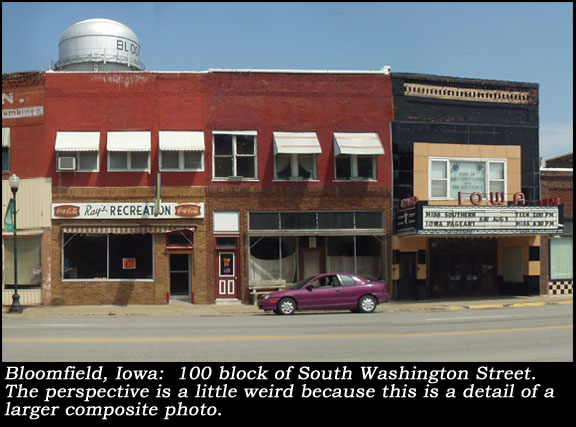 We stopped for lunch in Bloomfield, a nice little county seat with a handsome courthouse on a bustling square. The Iowa Theatre has a cool Moderne façade, and two doors down there’s a vintage Coke sign over Ray’s Recreation. We had lunch at Rancho Centinela on the square; it’s a Mexican restaurant occupying a huge storefront—6000 square feet, says one resource—that I suspect might have been a department store in a previous life.
We’re carrying Buildings of Iowa with us; it’s one volume in a series of books published by the American Institute of Architects, and it lists notable buildings in many of the towns we’re passing through. I’m most interested, obviously, in mid-20th-century relics, so when we hit Ottumwa I seek out the Rowe Drug Store. It’s supposed to be a Streamline Moderne classic, clad in neon and midnight-blue-and-cream Vitrolite. At the listed address is a tiny, nondescript storefront swathed in stucco. It’s not a drug store anymore, and all the Moderne finery is gone. The only hint that this is even the correct address is a capital R set in the tile at the entrance.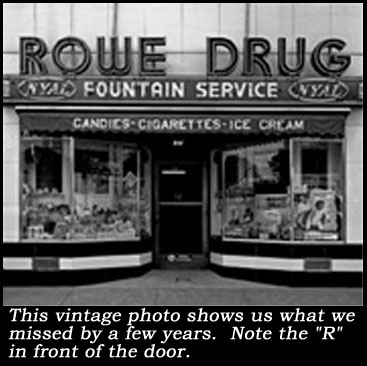 Oskaloosa is a bust too, as I’m looking for the old Rivola Theater that’s listed on CinemaTour. It’s gone (though visible at Cinema Treasures); entire blocks of the main drag have been replaced by a modern strip center that’s supposed to act as a natural extension of the old business district. There’s a farmers’ market set up along one side of the square, though, and Katie scores some tomatoes and blackberries.
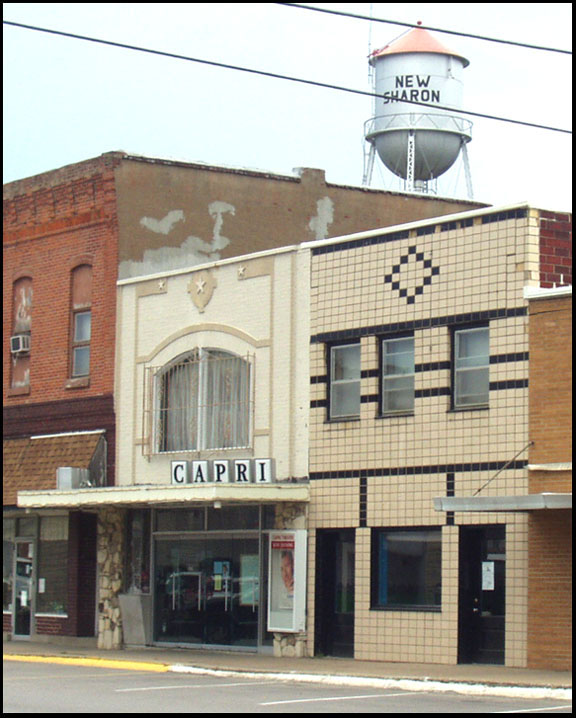 There’s a nice surprise in New Sharon: The Capri Theatre is a well-preserved example of an older cinema getting a 1960s makeover. The entire entrance is uninterrupted glass, and atop the marquee are backlit letters in individual boxes spelling CAPRI. Theatres built or remodeled in this style are often a curious mix of rough stone facing and poodly wrought-iron, and the Capri is a fine example. The venue is run by volunteers, and it’s open only on weekends—but the $1.50 admission charge is hard to beat.
There were a couple of things I wanted to check out in Malcom, but an angry-looking storm cloud is literally following us up the highway so we buzz on through in hopes of leaving it behind. The coast is clear by the time we hit Traer, so we check out the famous Winding Staircase that was built in 1894 for direct access to a second-floor newspaper office. Just down the block is the Traer Theatre, which is run by the city and is presently being remodeled.
WATERLOO/CEDAR FALLS
We had reservations at the Quality Inn in Waterloo. After everything was set up, I discovered TripAdvisor.com, and checked out the users’ comments on our hotel. One traveler noted that the Quality Inn was in the “WORST neighborhood in all of Iowa” and that the outer doors required no key-cards for entry: “You could just walk in at all hours and hop on the elevator up to the rooms, no questions asked.” Well, how the hell else are you supposed to get in when you first arrive, before you’ve registered? The restaurant and bar are both open to the public, and if their doors to the hotel lobby were locked, it would be a fire hazard. Myself, I worry more when I arrive at a motel and I have to be buzzed in. There are three locks on the door to your room, worry-wart. Use ‘em.
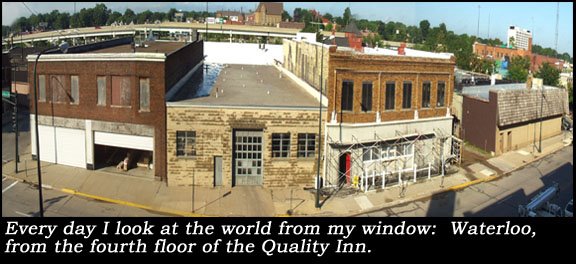 True, the Quality Inn was not in the prettiest of neighborhoods, but it didn’t look particularly dangerous to me. There were at least four bars within rock-throwing distance, but we didn’t hear any drunken hollering during our stay. The immediate area also contained an ethnic grocery, several warehouses, more hotels, a convention center, a Subway restaurant, and a pizza parlor with the repellently cutesy habit of spelling its product “peetza.” I would’ve thought the hotel just fine, even if I hadn’t been named “Guest of the Day” and gotten upgraded to a two-room suite with a whirlpool tub!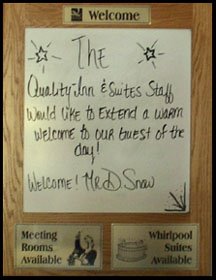
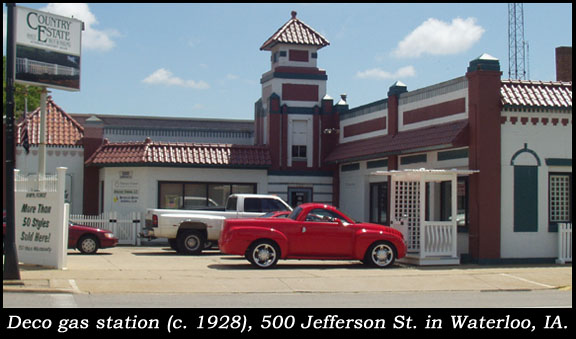 In the morning, Buildings of Iowa led us to a swell art-deco gas station (now a fence store), and further exploring revealed a vintage neon sign in the shape of a fez …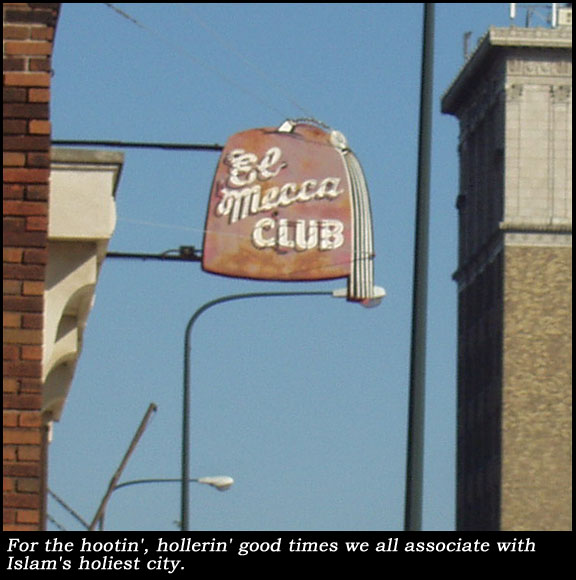
 …and this wonderful sculpture in front of the Five Sullivan Brothers Convention Center. I got to wondering about the Sullivans: Were they local mavens of commerce? A comedy troupe, perhaps? Sadly, no. A little research revealed that they were five local siblings, ages 19 thru 27, who served together on the USS Juneau in WWII and were all killed when the ship was attacked in 1942. The armed forces usually didn’t allow siblings to serve together, but the Sullivans had insisted on it.
Waterloo and neighboring Cedar Falls, a college town, have a pretty impressive network of bicycle trails, and we rode over 20 miles through the parks and suburbs and along the river. (Trail maps and other local resources are available at the Chamber of Commerce—on Main Street just south of the Cedar River—and just down the road at an old gas station that’s been converted into a tourist-information kiosk.)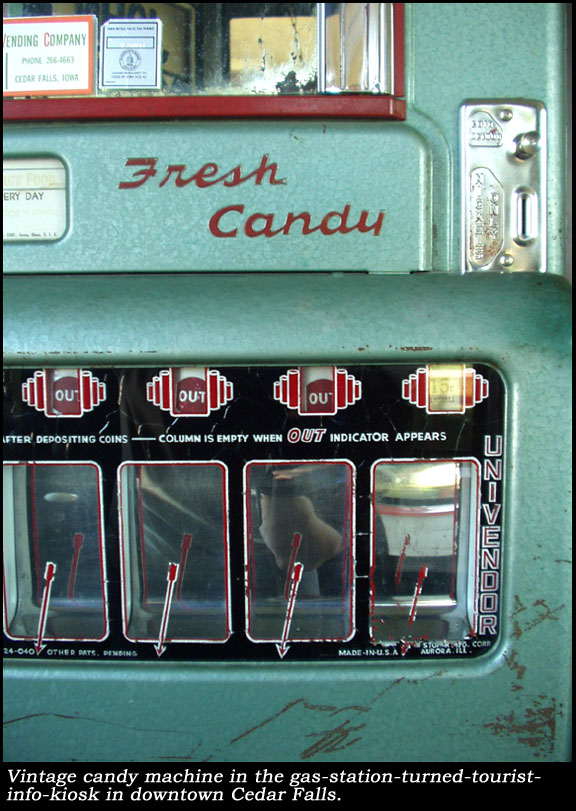 Main Street in Cedar Falls has undergone an amazing transformation in the last few years. The sidewalks have been upgraded with new trees, benches and bike racks, and shops and restaurants have multiplied. Cup of Joe, a coffeehouse conveniently located at the nexus of the bike trails by the river, was celebrating its eleventh anniversary on the day of our visit, and the proprietor felt very fortunate to have staked a claim on Main Street well ahead of the rush. The coffeehouse is blessed with a perfect location, great java, a friendly staff, and an incredible collection of early-‘60s Danish Modern furniture.
Directly across the street is the recently-restored Cotton Theatre. Now renamed the Oster Regent, it presents live entertainment.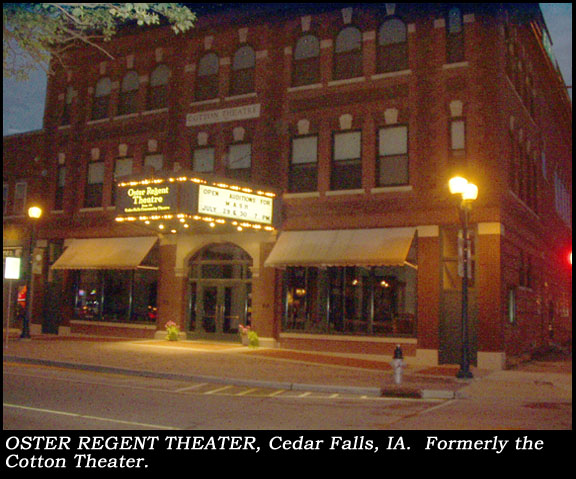 A few doors down, the historic Blackhawk Hotel offers quaint-yet-classy accommodations.
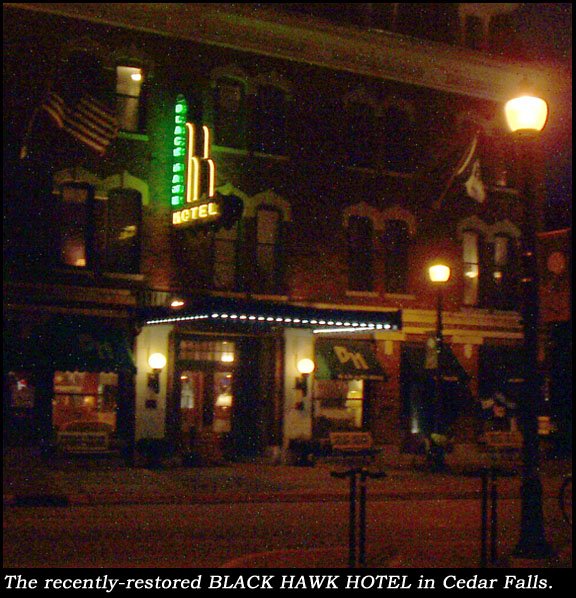 Main Street also offers a wide variety of restaurants, many of which are run by the multi-concept Barmuda chain—we had dinner at Beck’s Sports Grill, which is also a microbrewery. There’s also a bike shop, a handsome modern library, an array of public sculpture, and—just a few steps off of Main on 4th Street—a vintage Maid-Rite Sandwich Shop, serving loose-meat burgers Midwestern style.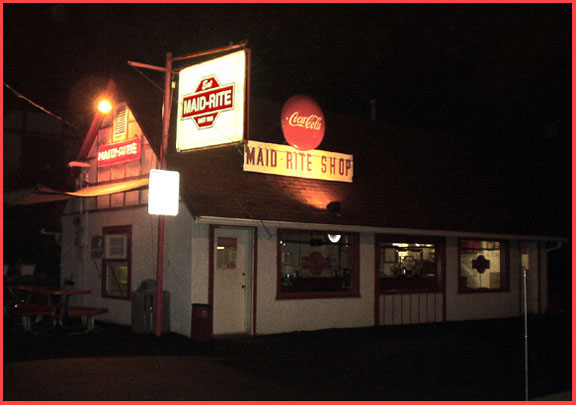
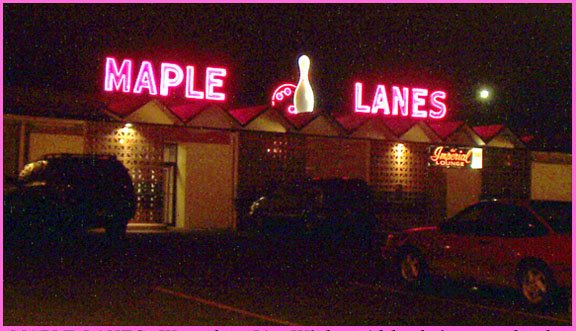
 A little further out in suburban Cedar Falls, my eye was caught by the vintage neon at the Panther Lounge and the venerable Maple Lanes. I wish I’d had time to check out the Imperial Lounge, or at least go into the bowling alley and see if the interior was as retro-fabulous as the exterior! (There are NO photos on their website, unfortunately.)
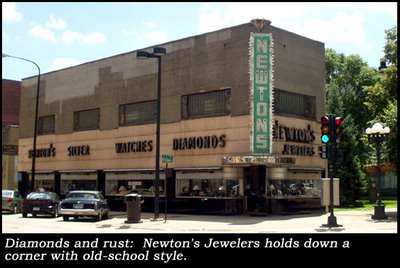
 Among all the sights we saw in the Cedar Falls/Waterloo area, I’d say the place most deserving of the Mid-Century Dream “Don’t Go Changin’” award is downtown Waterloo’s Newton’s Jewelers. Now THAT’S some undeniable signage!
 We had to get going before we could explore the town any further. Fortunately, someone with a little more time to spend in Waterloo (and other Iowa cities) has documented it more extensively: http://www.absolutedsm.com/waterloo_photo_page.htm
NEXT INSTALLMENT: Waterloo to Minneapolis.
UPDATE: Reader Aaron Bolton shares news that Newton's is closing after 93 years. The owner is pursuing other jewelry-related endeavors that afford her greater opportunity to travel. I can respect that, obviously! Now, anybody got a good home for a two-story-tall neon sign?